

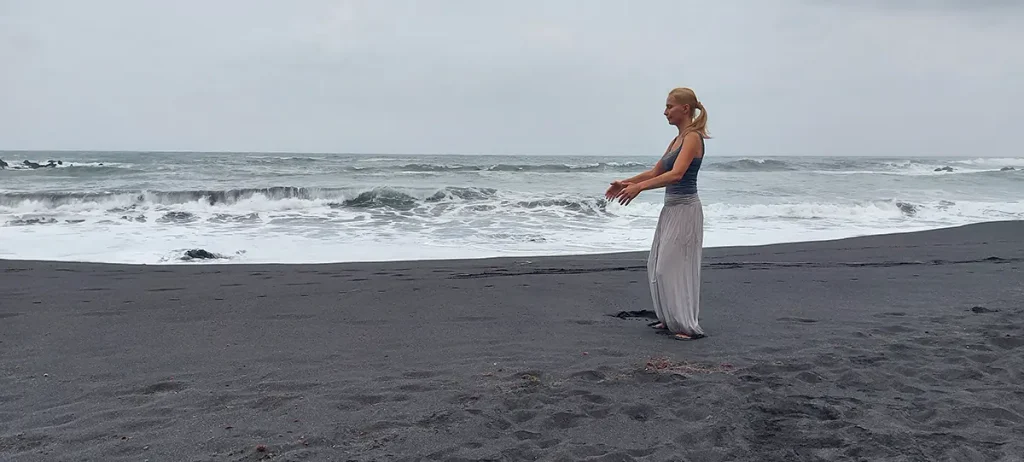
It feels almost miraculous to watch the waking light transform everything around me: first turning the darkness and black sand silver, then slowly bringing the colours back as the first rays of sunlight touch the landscape.
When I begin my practice, I am usually completely alone in this part of the coast. Only in the small bay a little further up is there a determined little group each morning, getting ready for a swim and taking on the sometimes wilder waves.
A little later, the “familiar strangers” begin to appear along the shore: the man who makes peculiar movements as he walks, the athletic young woman whose workout includes some particularly funny-looking exercises, the elderly couple where the woman almost always wears yellow. Then come the runners and the dog walkers, accompanied by dogs that are sometimes goofy and playful, sometimes distinctly grumpy…
We are a little like a family. After a little over two years, I have started to find my place here, and at last I feel at home again. And qigong seems to form an endless bridge between the past and the present.
A few days ago, Zoli, my husband, came down with me and captured some of this intimate atmosphere. I thought I would share with you a beautifully captured moment of timelessness.
What does home really mean?
What makes a place feel like home? And what makes it remain foreign to us? I moved to Tenerife two and a half years ago, and only now have I begun to feel truly at home on this otherwise wonderful island.
By now, home means something different to me than it once did. It is no longer a place so much as an emotional state.
- Home is where I am surrounded by love.
- Where I feel safe.
- Where the surroundings feel familiar and welcoming.
- Where I am free to be myself.
- Where I have living, supportive human relationships.
- Where people help me when I’m in trouble.
- Where there is someone I can turn to even when I simply feel like being with another person.
- Home is where the door of the house is open — and the door within me as well.
- Where Lélekkapu (Soul Gate) is open…
My home now extends far beyond the walls of the house I live in. The coast where I greet the morning has become part of my home; so has the promenade leading into town, the little Csillag café beside the church, the neighbourhood shop, the pharmacy, the fish shop — all of them are part of home now.
So are the people with whom I share different degrees of connection. Home is not only my close family and closest friends, but also the neighbours who were warm and accepting from the very first moment, the familiar strangers I see regularly, the pharmacist who is always calm and surprisingly soft-spoken by local standards, and the unfailingly polite young man in the greengrocer’s.
At last, my home no longer ends at my doorstep.
So much so that the house we live in was actually the last thing to become home.
The fact that things turned out this way was not accidental. An inner change had to take place — one that is essential if we want to integrate into a new and unfamiliar environment. There is not much of a shortcut around it: we have to “get out of our heads” and loosen our grip on the fixed ways of thinking that used to work for us. Especially because in a new environment, the old ways often simply don’t work at all.
At first, it is not easy to move beyond the frustration of discovering that what used to work no longer does. What I am about to say may sound strange, especially if you have never lived abroad for any length of time…
To find our place within a culture different from our own, we have to attempt something almost impossible: to step outside our own skin. For me, that meant letting go of a piece of my Hungarian identity — at least for a while.
To truly make room for a new culture, we simply need some extra space within ourselves.
If I do not clear some room inside, if I do not open the doors and windows within me, integration becomes almost impossible. Of course, letting go of my Hungarian identity was only ever an illusion. How could I let go of who I am? As someone who works with constellations, I also know that “without roots, we cannot fly”. At the same time, temporarily stepping outside my Hungarian way of seeing things was essential if I was going to receive and accept all the new impressions, unfamiliar customs, and different approaches to handling situations, solving problems and relating to time. Because, after all, the Hungarian soul tends to come with a Hungarian ego as well…
Encountering ways of doing things that differ from our own, together with culture shock, can initially produce a considerable amount of frustration. And frustration can easily turn into judgement, followed by withdrawal. That is not the most helpful combination when you are trying to find your place, make a home in unfamiliar surroundings, or at least learn to move through them with some ease.
The first year and a half was largely about loosening some of the patterns rooted in my Hungarian identity and learning to receive. The year that followed was about integrating what I had learned back into that identity.
I deeply believe — or more accurately, I have experienced in myself — that opening ourselves to a culture different from our own does not tear us away from our roots. Quite the opposite: it enriches them.
Getting to know any kind of difference — whether it is another culture, a foreign language, a new workplace, or simply another person whose view of the world is very different from ours — has the potential to enrich us.
But to truly come to know what is different, we need to keep the gate of our inner world open, because as long as we remain behind our own walls, we cannot discover the world beyond them.