

Unconscious beliefs
There is a belief that the more tasks you have, the more important you are — and the more important you are, the more valuable you must be. And naturally, the more valuable you are, the more people will love you.
You can tell that someone has a lot to do because they are in a hurry. They are constantly rushing. Because if you have somewhere you urgently need to be, you must be important, valuable, almost indispensable. Your time is worth more than the time of someone who isn’t rushing anywhere — or at least isn’t rushing quite as much.
This widely accepted social belief was one of the reasons I could quite happily work sixteen hours a day in my thirties. More than once, I had a client still proofreading at my home — my home office — at midnight. Because, obviously, both of us were extremely important, and the task itself was extraordinarily important too.
And I really did feel terribly important back then. It took me quite a while to look beyond the hamster wheel and see one very simple fact: I was constantly using tasks to validate myself.
Every single day, I had to prove that I mattered. Yet deep down, all I really wanted was to be accepted — and perhaps to be loved a little more than I was capable of loving myself at the time.
What did tasks do to me?
I became increasingly rigid and tense. My spontaneity faded. And eventually, so did much of my joy.
I tried to break free from the grip of tasks.
I walked the Camino de Santiago twice, but even on the Camino I found it difficult not to turn each new stretch of the journey ahead of me into a task. During the first few days, everything was a task… walking, buying food, finding somewhere to stay and settling in, doing the washing… I even hurried to reach the hostel in time. On a pilgrimage!
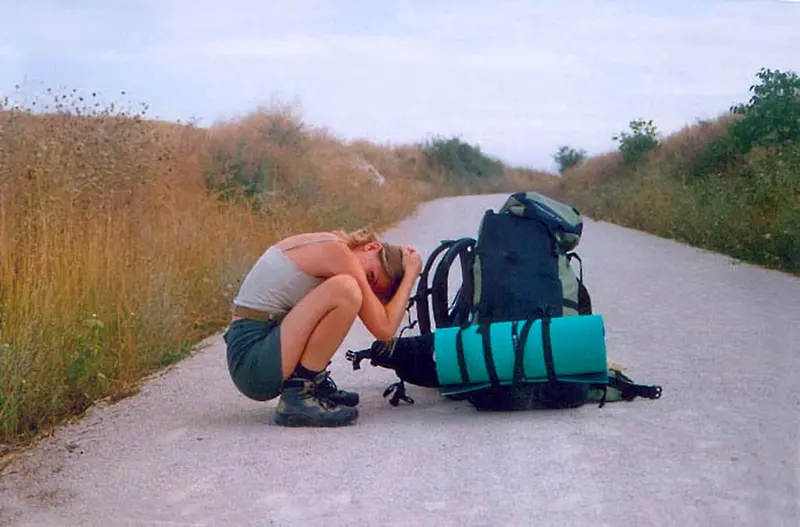
I have to laugh when I think about it now — especially the ego-knot that tightened inside me when I arrived at the first hostel and discovered that there were another three hundred people just like me. Exactly like me: shorts, smelly hiking boots and a dusty backpack.
Then there was qigong practice. At first, it brought me joy and a sense of wonder at the unfamiliar sensations appearing in my body and the changes in my perception. Then practising became a task, and the joy disappeared — fortunately, only for a while.
The change Tenerife brought
Feladatorientáltságomnak a kegyelemdöfést Tenerife adta meg. Ez a sziget minden napjával élni tanít – teljesen másképp, mint ahogy előtte tettem. Egyre jobban látom, ahogy a feladatok elveszik az életkedvemet, és ezzel azt hiszem, a helyiek is így lehetnek. Azt látom, hogy az itteniek a feladataikat inkább olyasfajta tevékenységeknek tekintik, amelyek lehetőséget kínálnak valami másra.
So the shop assistant calmly chats with the customer. The pharmacist is in no hurry. A nurse half-sings her words to me while checking my details. They seem to know perfectly well that none of us is important enough to take ourselves — or whatever we happen to be doing — quite so seriously.
"Mañana" and "no te preocupes" have worked their way under my skin. I am not important. And I don’t need to be so important that I have to rush anywhere.
I. Am. Not. Important.
So perhaps I don’t have to meet everyone’s expectations? Could it really be enough simply to be as I am? These were the questions going around in my mind.
Since then, whenever I notice myself beginning to treat something I need to do as a task, I stop for a moment. I watch the ego-knot begin to tighten as I once again try to prove to myself that, after all, I really am important, valuable and worthy of love.
Then, inwardly, I sit down beside myself and let the ego-knot simply be there, just like all those terribly important tasks. And I stay there until the light once again falls on my insignificance.
If, alongside recognizing the need to prove yourself that can lie behind tasks, you would also like to explore what it means to remain open in uncertainty, read On Not Knowing .